
TPCi Banning Graded Slabs at Events Is a Step in the Right Direction — But It Doesn't Go Far Enough
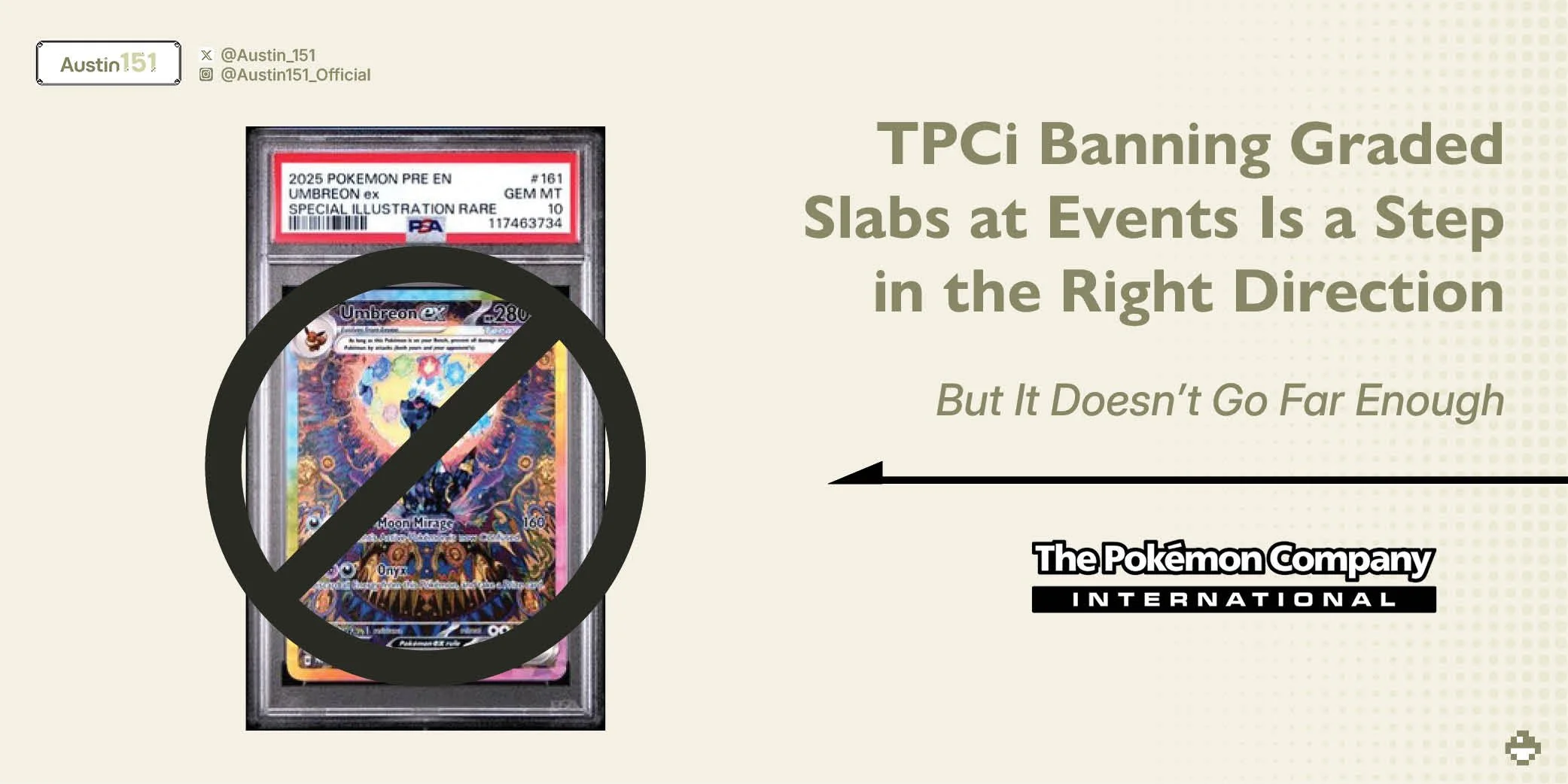
TPCi just dropped a quiet policy change that's going to ruffle some feathers: partnered vendors at official events — NAIC, Worlds, Indianapolis Regionals — can no longer sell graded slabs, items over $1,000, or most Japanese Pokémon Center products. No public announcement. Just an internal memo, effective immediately.
My take? Mostly good. But let me explain why it doesn't fully solve the problem.
The Graded Slab Ban Makes Sense
I like graded cards. I genuinely do. There's real value in authentication, preservation, and being able to verify what you're buying. But you have to acknowledge what graded slabs have become at events — and what PSA specifically has been dealing with.
PSA is pausing Value Tier submissions starting June 2nd due to a demand spike. Their turnaround times have ballooned, their pricing keeps climbing, and their reputation has taken some real hits with collectors questioning consistency. When you've got 11-year-olds at vendor tables flipping $500 slabs instead of learning what a set code means, that's a problem — and it's a problem TPCi created by letting it get this far.
Graded slabs have no place in competitive play. They're a collector's market item. And when kids are watching other kids buy slabs instead of playing the game at official Pokémon events, you've lost the plot on what those events are supposed to be. TPCi was right to pull this back. You’re also never going to see a $1,000 card in competitive play so there really isn’t a reason to be selling cards valued over $1,000 on the secondary market.
The PSA connection matters too. If TPCi ever wants to launch their own authentication or grading program — which, honestly, feels inevitable — you can't have your events propping up third-party grading companies that have had very public quality issues. This is them creating distance, and I get it.
The Japanese Pokémon Center Ban Has More Nuance
This one's a little more complicated and I think most people are sleeping on the real reason behind it.
Japan just announced they're requiring government ID verification for select Pokémon Center Online purchases starting around August 2026. That system is built to lock purchases to Japanese residents and stop overseas buyers from scooping up limited product before it ever hits local shelves.
So think about what it would look like for TPCi to simultaneously allow their partnered vendors to sell that same Japanese-exclusive product at a markup at Worlds. Fans in Japan can't get it. But you can walk up to a vendor table in Indianapolis and pay double for it. That's the optics they're trying to avoid — and fair enough.
Here's Where I Push Back
The ban needs to go further.
If the goal is to make events feel like Pokémon events again — not a reseller convention with a side of Regionals — then the conversation about sealed product can't stop at Japanese exclusives. We know what happens next weekend. Vendors who can't sell slabs or Japanese product are still going to be moving current booster boxes, ETBs, and collection tins at market price or above.
And those aren't rare. Those aren't exclusive. Those are products sitting on Walmart and Target shelves right now. If a kid or their parent walks up to a vendor table and pays $180 for a booster box they could've grabbed at MSRP on their way to the event, that's still a bad outcome. Resellers didn't get into this hobby to leave money on the table — they'll find the next avenue.
The slab and Japanese product ban removes the most egregious stuff. But the core resale culture at events isn't going away with one policy memo.
Bottom Line
TPCi is sending a clear message: official events should feel like celebrations of the game, not investment expos. I'm with them on that. The graded slab ban specifically makes sense — both philosophically and strategically, given where the relationship between TPCi and third-party grading companies appears to be heading.
But this is step one, not the solution. Until there's a harder line on current sealed product being sold above MSRP at official events, resellers will just rotate their inventory and adapt.
The right move was made. Now let's see if they follow through on the rest of it.
